PracticeVCE The Open Group OGEA-103 Different Formats
Wiki Article
P.S. Free 2026 The Open Group OGEA-103 dumps are available on Google Drive shared by PracticeVCE: https://drive.google.com/open?id=1x92iJIz3vV7B0srOScsr7xwopJptz3bA
Compared with our PDF version of OGEA-103 training guide, you will forget the so-called good, although all kinds of digital device convenient now we read online to study for the OGEA-103 exam, but many of us are used by written way to deepen their memory patterns. Our PDF version of OGEA-103 prep guide can be very good to meet user demand in this respect, allow the user to read and write in a good environment continuously consolidate what they learned. And the PDF version of OGEA-103 learning guide can be taken to anywhere you like, you can practice it at any time as well.
The OGEA-103 exam consists of two parts, Part 1 and Part 2. Part 1 is a multiple-choice exam that tests the candidates' knowledge of the TOGAF Standard, while Part 2 is a scenario-based exam that tests the candidates' ability to apply the TOGAF Standard in real-world situations. OGEA-103 exam is open book, meaning that candidates are allowed to use the TOGAF Standard during the exam. Passing the OGEA-103 Exam is a valuable credential for enterprise architects, as it demonstrates their proficiency in the TOGAF Standard and their ability to create and manage enterprise architectures that align with the business goals of an organization.
>> OGEA-103 Trusted Exam Resource <<
Free PDF Quiz 2026 Authoritative The Open Group OGEA-103 Trusted Exam Resource
Are you still worried about you exam? If you do, then trying the OGEA-103 exam torrent of us, we will make it easier for you to pass it successfully. OGEA-103 exam dumps of us are not only have the quality but also have certain quantity, it will be enough for you to deal with your exam. In addition OGEA-103 Online Test engine can record the process of your learning, and you can have a review of what you have learned. OGEA-103 Soft test engine stimulates the real environment of the exam, and you can know what the real exam looks like through this version.
The Open Group TOGAF Enterprise Architecture Combined Part 1 and Part 2 Exam Sample Questions (Q38-Q43):
NEW QUESTION # 38
According to the TOGAF standard, what are the two levels of risk that should be monitored?
- A. Operational and Strategic level
- B. Initial and Residual level
- C. Technical and Financial level
- D. Mitigated and Revised level
Answer: B
Explanation:
Comprehensive and Detailed In-Depth Explanation from Expert in Enterprise Architecture, guiding in TOGAF and ArchiMate:
TOGAF adopts a formal risk management perspective aligned with widely accepted enterprise risk management practices. Within the ADM, risks are identified, analyzed, treated, and monitored throughout all phases, particularly during Architecture Governance and Implementation Governance.
TOGAF explicitly distinguishes between:
* Initial Risk:The level of risk identified before any mitigation actions are applied. This represents the inherent exposure associated with an architecture decision, solution, or implementation approach.
* Residual Risk:The level of risk that remains after mitigation measures have been applied. This residual risk must be explicitly accepted, monitored, or further treated by governance bodies.
Why Option D is correct:
* TOGAF requires both Initial and Residual risks to be documented and monitored to ensure informed decision-making and effective governance throughout the ADM lifecycle.
Why the other options are incorrect:
* A. Technical and Financial level: These are categories of risk, not the two monitoring levels defined by TOGAF.
* B. Mitigated and Revised level: These terms are not used as formal risk levels in TOGAF.
* C. Operational and Strategic level: These describe business risk domains, not TOGAF-defined monitoring levels.
Authoritative TOGAF References:
* TOGAF Risk Management
* TOGAF Architecture Governance
* TOGAF ADM Guidelines and Techniques - Risk Management
NEW QUESTION # 39
Consider the following ADM phases objectives.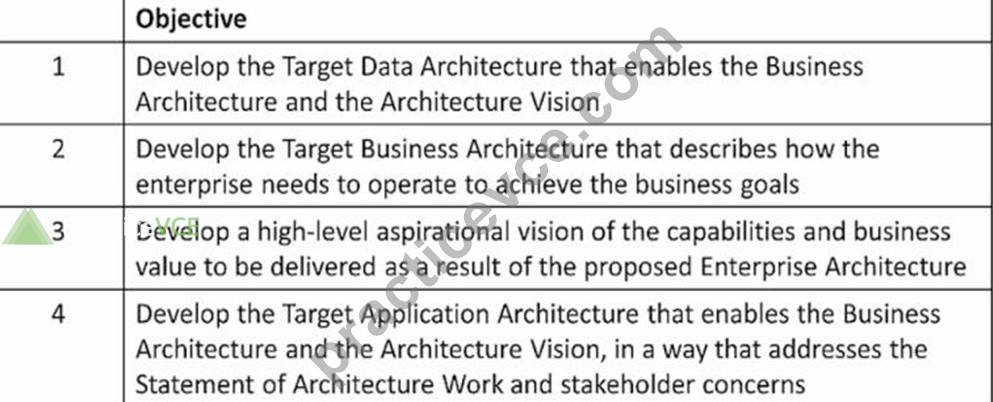
Which phase does each objective match?
- A. 1A-2B-3C-4D
- B. 1C-2D-3B-4A
- C. 1B-2D-3A-4C
- D. 1C-2B-3A-4C
Answer: D
Explanation:
The objectives in the table are related to the development of target architectures and the architecture vision, which are the outputs of the following ADM phases:
Phase A: Architecture Vision, which develops a high-level aspirational vision of the capabilities and business value to be delivered as a result of the proposed Enterprise Architecture3 Phase B: Business Architecture, which develops the Target Business Architecture that describes how the enterprise needs to operate to achieve the business goals.
Phase C: Information Systems Architectures, which develops the Target Data Architecture and the Target Application Architecture that enable the Business Architecture and the Architecture Vision, in a way that addresses the Statement of Architecture Work and stakeholder concerns.
Phase D: Technology Architecture, which develops the Target Technology Architecture that enables the logical and physical application and data components, addressing the Statement of Architecture Work and stakeholder concerns.
Therefore, the correct match is 1C-2B-3A-4C, as shown below: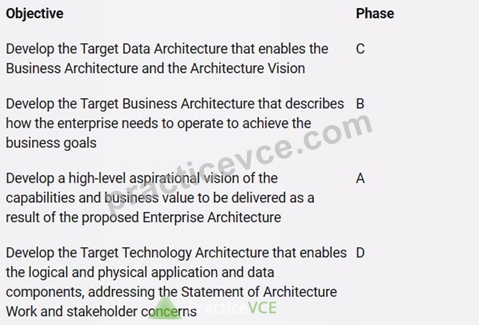
NEW QUESTION # 40
Please read this scenario prior to answering the question
You are working as an Enterprise Architect at a large supermarket. The company runs many retail stores, as well as an online grocery shop. Many of the stores used to remain open 24/7, but the number has decreased in recent years. Instead, they now focus on fulfilling online orders during the night.
The company has a mature Enterprise Architecture (EA) practice and uses the TOGAF standard for its architecture development method. The EA practice is involved in all aspects of the business, with oversight provided by an Architecture Board with representatives from different parts of the business. The EA program is sponsored by the Chief Information Officer (CIO).
Each store uses a standard method to track sales and inventory. This involves sending accurate timely sales data to a central Al-based inventory management system that can predict demand, adjust stock levels and automate reordering. The central inventory management system is housed at the company's central data center.
The company has bought a major rival. The Chief Executive Officer believes that a merger will enable growth through combined offerings and cost savings. The decision has been taken to fully integrate the two organizations, including merging retail operations and systems. This means that duplicated systems will be replaced with one standard retail management system. Also, the company will reduce the number of applications that are used. The CIO expects significant savings will be achieved by implementing these changes across the newly merged company.
One improvement that the rival has successfully implemented is the use of hand-held devices within stores, for both customers and staff. This has increased both customer and staff employee satisfaction due to the time savings this has brought. The CIO has given the go-ahead to roll out the devices in all stores but has stated that training on how to use the hand-held devices should be brief because there are a lot of employees, many of whom are part-time.
The Request for Architecture Work to oversee the merger has been approved. The project has been scoped and you have been assigned to work on it. Your role includes managing the architecture for the retail stores.
Refer to the scenario
You have been asked to confirm the most relevant architecture principles for the transformation.
Based on the TOGAF Standard, which of the following is the best answer?
[Note: The sequence of the principles listed in each answer does not matter. You should assume the company follows the set of principles that are provided in the TOGAF Standard, ADM Techniques, Architecture Principles chapter. You may need to refer to section 2.6 located in ADM Techniques within the reference text to answer this question.]
- A. Common Use Applications, Data is an Asset, Data is Accessible, Ease of Use, Business Continuity
- B. Common Vocabulary and Data Definitions, Compliance with the Law, Requirements Based Change, Responsive Change Management, Data Security
- C. Control Technical Diversity, Interoperability, Data is an Asset, Data is Shared, Business Continuity
- D. Maximize Benefit to the Enterprise, Common Use Applications, Data is an Asset, Responsive Change Management, Technology Independence
Answer: D
Explanation:
Key aspects of the scenario:
Business Objective:
A merger is happening to combine offerings, reduce costs, and achieve operational efficiency.
The goal includes fully integrating retail operations and systems, replacing duplicated systems, and reducing the number of applications used.
Technological Improvements:
A central AI-based inventory system is in place.
Hand-held devices for stores have improved customer and staff satisfaction and increased efficiency.
Scope of Architecture Work:
Integrating the merged systems.
Managing retail architecture to optimize operations.
TOGAF Alignment:
TOGAF principles aim to ensure the architecture supports business transformation effectively while aligning with governance and best practices.
Best answer analysis:
Option 1:
Maximize Benefit to the Enterprise: Aligns with the merger goals of cost reduction and efficiency.
Common Use Applications: Matches the goal to reduce duplicated systems.
Data is an Asset: Central AI system depends on accurate and reliable data.
Responsive Change Management: Necessary to support the transition and manage organizational impacts.
Technology Independence: Encourages selecting flexible, scalable solutions post-merger.
This option comprehensively aligns with the scenario.
Option 2:
Control Technical Diversity: Important but less emphasized than cost reduction and application unification.
Interoperability: Relevant, but less critical compared to principles addressing business value.
Data is an Asset: Relevant.
Data is Shared: Implied in centralized inventory but not directly stated.
Business Continuity: Important but not the main focus here.
This option partially fits but lacks emphasis on business outcomes.
Option 3:
Common Vocabulary and Data Definitions: Indirectly helpful but not central to the transformation.
Compliance with the Law: Always critical, but no explicit legal issues are mentioned.
Requirements-Based Change: General principle but not transformation-specific.
Responsive Change Management: Relevant.
Data Security: Important but not a central concern in the scenario.
This option focuses more on governance and less on merger goals.
Option 4:
Common Use Applications: Relevant to reducing duplicate systems.
Data is an Asset: Relevant.
Data is Accessible: Fits with AI system and handheld devices but is a subset of "Data is an Asset." Ease of Use: Relevant to handheld devices but not a core transformation principle.
Business Continuity: Important but secondary to cost and efficiency.
This option focuses more on usability and accessibility rather than transformation objectives.
NEW QUESTION # 41
Please read this scenario prior to answering the question
You are employed as an Enterprise Architect for a company that supplies products for industrial production automation. You are part of an Enterprise Architecture (EA) team that has responsibilities across the company.
The company has multiple manufacturing plants where it assembles both standard and customized products.
Each of these plants operates its own planning and production scheduling systems, as well as applications and control systems that drive the automated production line.
During a recent management meeting, the agenda included discussion of how a competitor company had improved production efficiency by replacing multiple planning and scheduling systems with a single cloud- based system. This had reduced lifecycle costs through reduced duplication, lowered software maintenance costs, and supported incremental replacement. The CIO claimed the company's current systems architecture is already optimized. However, as the competitor has reported better financial results, the CEO has requested an investigation of a cloud-based solution.
In response, the Architecture Board approved a Request for Architecture Work to find out if such an architecture transformation would lead to efficiency improvements. You have been asked to help the architecture team with this project.
A concern of the plant managers is the safety and dependability of using a remote centralized system for planning and scheduling production. The system they choose must also be able to work with the local partners in the supply chain at each plant.
The company has an Enterprise Architecture (EA) practice and uses the TOGAF standard as the basis for its work. It has been running for many years and has established governance and development processes for EA.
The Chief Information Officer (CIO) sponsors the Enterprise Architecture program.
Refer to the scenario
You have been asked to describe how you will start the architecture project.
Based on the TOGAF standard, which of the following is the best answer?
- A. You would run a series of interviews at each manufacturing plant to discover and document business requirements. This would also help you understand the systems and integrations with local partners.You would create a matrix of stakeholders and their primary concerns. You would then determine and record the main stakeholder requirements for the architecture. You would then create clear high-level descriptions of the current and future architectures.
- B. You would conduct a series of workshops with the local partners to gather requirements from them.
Based on the findings from the workshops, you would define a preliminary Architecture Vision including summary views, high-level requirements, and high-level definitions of the baseline and target environments from a business, information systems, and technology perspective. You would then use the Architecture Vision to build agreement among the local partners. - C. You would gather information from your suppliers and conduct a series of briefings with those of them that are on the current approved supplier list. Based on the findings from the research, you would define a preliminary Architecture Vision including summary views, high-level requirements, and high-level definitions of the baseline and target environments from a business, information systems, and technology perspective. You would then use the Architecture Vision to build agreement among the key stakeholders.
- D. You would develop baseline and target Architectures for each manufacturing plant, ensuring that the views corresponding to selected viewpoints address key concerns of the stakeholders. A business case, together with performance metrics and measures should be defined to ensure the architecture meets the business needs. A consolidated gap analysis between the architectures will then validate the approach and determine the capability increments needed to achieve the target state.
Answer: B
Explanation:
Option A best aligns with TOGAF Phase A: Architecture Vision, which is the starting phase for an architecture development cycle in TOGAF. This phase sets the foundation for the architecture engagement and ensures alignment with stakeholders and their concerns, especially when evaluating a major transformation like moving to a cloud-based planning and scheduling system.
# Key TOGAF Concepts Supporting Option A:
1. Phase A: Architecture Vision Objectives
* Establish the high-level scope, constraints, and expectations.
* Identify stakeholders and define their concerns and business requirements.
* Create the Architecture Vision, which includes:
* Summary-level Baseline and Target Architecture views (business, data, application, and technology).
* Initial requirements and key concerns.
* Stakeholder buy-in and approval for moving forward.
2. Engagement with Stakeholders
* In this case, the plant managers and local supply chain partners have concerns regarding safety and dependability.
* TOGAF emphasizes early engagement with business stakeholders to ensure concerns are identified and incorporated into the vision.
3. Creating Architecture Vision Document
* A deliverable of Phase A.
* Includes high-level descriptions of the baseline and target architectures, initial business goals, and stakeholder viewpoints.
* Used to build agreement and obtain formal approval to proceed with detailed architecture work in later phases (B-D).
# Why Other Options Are Incorrect:
* B: Focuses on suppliers and not the actual stakeholders impacted by the architecture - i.e., plant managers and internal operations. This diverts from TOGAF's stakeholder-driven approach in Phase A.
* C: This reflects Phases B-D of the ADM (Business, Information Systems, and Technology Architecture). It is too detailed and premature for the start of the project. In Phase A, you don't yet develop full baseline and target architectures or conduct a consolidated gap analysis.
* D: While interviewing stakeholders is valid in Phase A, this option lacks a holistic view of the Architecture Vision development, and skips the TOGAF requirement to produce summary views of the baseline and target architectures and to use them to drive stakeholder buy-in. It is tactically correct, but strategically incomplete.
# TOGAF Source References:
* TOGAF 9.2 - Section 6.2 (Phase A: Architecture Vision)
"The Architecture Vision describes how the proposed architecture support the business goals, and the strategic direction. It also provides a high-level description of the baseline and target architectures and identifies key stakeholders and concerns."
* TOGAF 9.2 - Part IV, Architecture Content Framework
"The Architecture Vision includes the scope, constraints, and expectations. It forms the basis for approval to proceed with further architecture development."
NEW QUESTION # 42
Which section of the TOGAF template for Architecture Principles should highlight the requirements for carrying out the principle?
- A. Rationale
- B. Statement
- C. Implications
- D. Name
Answer: C
Explanation:
Explanation
The Implications section describes the impact of adhering to the principle on the organization, the processes, the information systems, and the technology23. It also identifies the changes, costs, and risks that may result from applying the principle23. The Implications section helps to communicate the benefits and consequences of the principle to the stakeholders and to guide the implementation and governance of the architecture23.
The other sections of the TOGAF template for Architecture Principles are1:
*Name: This section provides a short and memorable name for the principle that represents its essence and purpose23. The name should not mention any specific technology or solution23.
*Statement: This section provides a concise and formal definition of the principle that expresses the fundamental rule or constraint that the principle imposes23. The statement should be clear, unambiguous, and testable23.
*Rationale: This section provides the reasoning and justification for the principle, explaining why it is important and how it supports the business goals and drivers23. The rationale should also link the principle to the higher-level enterprise or IT principles that it elaborates on23.
References: 2: The TOGAF Standard, Version 9.2 - Architecture Principles 3: TOGAF 8.1.1 Online - Architecture Principles 1: Architecture Principles Template
NEW QUESTION # 43
......
PracticeVCE will provides the facility of online chat to all prospective customers to discuss any issue regarding, different vendors’ certification tests, OGEA-103 exam materials, discount offers etc. Our efficient staff is always prompt to respond you. If you need detailed answer, you send emails to our customers’ care department, we will help you solve your problems as soon as possible. You will never regret to choose OGEA-103 Exam Materials.
OGEA-103 Test Simulator Free: https://www.practicevce.com/TheOpenGroup/OGEA-103-practice-exam-dumps.html
- Credible Method To Pass The Open Group OGEA-103 Exam On First Try ???? Open website { www.vce4dumps.com } and search for ⮆ OGEA-103 ⮄ for free download ????Reliable Test OGEA-103 Test
- OGEA-103 Test Collection ???? Vce OGEA-103 Exam ???? OGEA-103 Test Collection ☸ Download ⇛ OGEA-103 ⇚ for free by simply entering ▷ www.pdfvce.com ◁ website ⏮Reliable OGEA-103 Exam Questions
- Real The Open Group OGEA-103 Questions with Free Updates – BUY NOW ???? Search for 《 OGEA-103 》 and obtain a free download on { www.dumpsquestion.com } ????Regualer OGEA-103 Update
- High Hit Rate OGEA-103 Trusted Exam Resource - Pass OGEA-103 Exam ???? Easily obtain free download of ➡ OGEA-103 ️⬅️ by searching on ✔ www.pdfvce.com ️✔️ ⬜OGEA-103 Reliable Test Camp
- Practice OGEA-103 Test ???? Dumps OGEA-103 Free Download ???? Latest OGEA-103 Exam Camp ???? Easily obtain free download of ( OGEA-103 ) by searching on ( www.practicevce.com ) ❤New OGEA-103 copyright Pdf
- OGEA-103 Popular Exams ???? Valid OGEA-103 Guide Files ???? OGEA-103 Reliable Exam Cost ???? Search for ✔ OGEA-103 ️✔️ and download exam materials for free through ➤ www.pdfvce.com ⮘ ????Exam OGEA-103 PDF
- Practice OGEA-103 Test ???? Reliable Test OGEA-103 Test ???? Reliable Test OGEA-103 Test ⛴ Open ✔ www.examcollectionpass.com ️✔️ enter 「 OGEA-103 」 and obtain a free download ????New OGEA-103 copyright Pdf
- Regualer OGEA-103 Update ???? Regualer OGEA-103 Update ???? Latest OGEA-103 Exam Camp ???? Download ⏩ OGEA-103 ⏪ for free by simply searching on ⮆ www.pdfvce.com ⮄ ????Valid OGEA-103 Guide Files
- Valid OGEA-103 Trusted Exam Resource bring you Fantastic OGEA-103 Test Simulator Free for The Open Group TOGAF Enterprise Architecture Combined Part 1 and Part 2 Exam ???? Simply search for “ OGEA-103 ” for free download on ➠ www.vceengine.com ???? ????Vce OGEA-103 Exam
- Latest OGEA-103 Test Format ???? Vce OGEA-103 Exam ???? Valid copyright OGEA-103 Questions ???? Open ▛ www.pdfvce.com ▟ enter 「 OGEA-103 」 and obtain a free download ????OGEA-103 Test Collection
- Credible Method To Pass The Open Group OGEA-103 Exam On First Try ???? Search for ☀ OGEA-103 ️☀️ and obtain a free download on ➤ www.prepawaypdf.com ⮘ ????OGEA-103 Complete Exam Dumps
- myportal.utt.edu.tt, myportal.utt.edu.tt, myportal.utt.edu.tt, myportal.utt.edu.tt, myportal.utt.edu.tt, myportal.utt.edu.tt, myportal.utt.edu.tt, myportal.utt.edu.tt, myportal.utt.edu.tt, myportal.utt.edu.tt, violaqyut262704.dreamyblogs.com, icelisting.com, declanlhrt351486.wiki-jp.com, www.stes.tyc.edu.tw, funny-lists.com, ezekielgpnq294044.therainblog.com, www.stes.tyc.edu.tw, thebookpage.com, imogenzcuf844420.ssnblog.com, Disposable vapes
2026 Latest PracticeVCE OGEA-103 copyright and OGEA-103 copyright Free Share: https://drive.google.com/open?id=1x92iJIz3vV7B0srOScsr7xwopJptz3bA
Report this wiki page